 |
 |
|||||
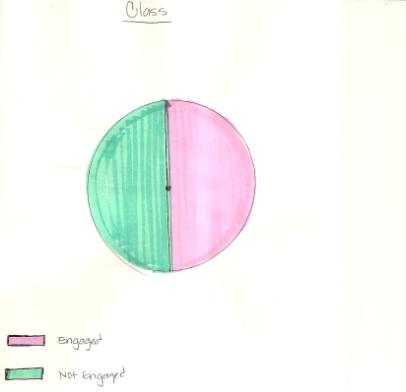
Data Cluster Meetings Once a month, hour long meetings were held at the National Teacher's Academy amongst grade level teachers to have an open dialogue about daily teaching practices and student data. Being able to participate in such meetings was an essential component of my residency experience, because it allowed me the opportunity to communicate with the school administrators and other grade level teachers about strategies and practices that were both effective and ineffective in our daily classroom routines. Most of the meetings were held by an administrative team member, and it was a very rewarding experience to see their active involvement in the classroom happenings of all their teachers. Above are two images of one of the last Data Cluster meetings that I attended. The conversation revolved around defining what student engagement was, what it looked like, and the reality of its occurrences in our classroom. What was most beneficial was hearing the common language about what strategies could be implemented school wide to create a more engaged and positive school environment. It was also beneficial to see how data Cluster meetings allowed for the opportunity to discuss and communicate teaching practices that would work together to increase cohesion and continuity for students as they transitioned through grade levels. 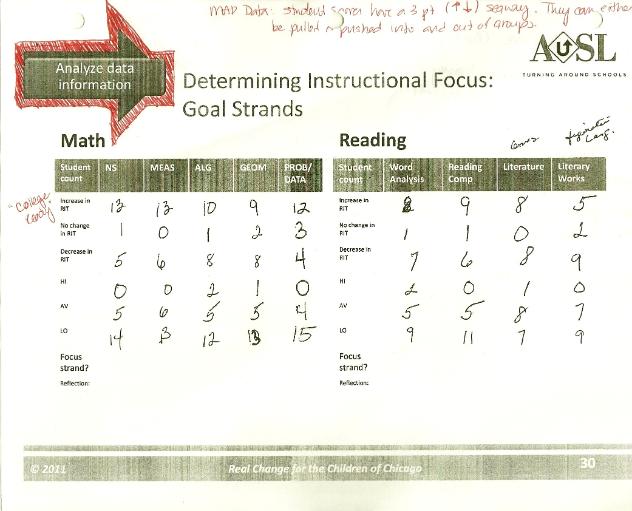
Professional Learning Communities Once a month for about two hoursl, for about two hours, all the National Teachers Academy Staff members met after school as a collaborative group to discuss practices that would impact students, teaching, and learning on a school wide level. Prior to coming to the National Teachers Academy, I felt that there was not a lot of discussion about the significance of NWEA Map Data and its implications towards student progress. As a resident at the National Teachers Academy, I found that the school functioned as a data driven entity. Their is common language towards providing students with access to a rigorous curriculum that will adhere to the notion of making them college ready. Being able to participate in such meetings with educators from all grade levels gave me the opportunity to communicate and work alongside with other members. One of the biggest projects during PLC was the construction of a student friendly rubric. I worked alongside with the K-2 grade level teachers to help create a holistic writing rubric that would serve as a document to highlight the academic and writing expectations of students. Once again, the collaborative efforts of the National Teachers Academy staff members was very rewarding, as teachers continued to work hard towards developing a common language and creating school wide expectations that would adhere to the notion of students meeting their academic potential.
Integrating Social Justice & Education One of the most exciting projects that I had the opportunity to participate in, was the collaboration amongst the third grade level teachers to create a social justice unit that would examine the social inequities amongst Chicago Public Schools. Being able to work with the other third grade teachers allowed for me to communicate and brainstorm different strategies that would be conducive to helping students understand the essential processes involved with discretionary funds. We collaborated to interview principals throughout the city of Chicago, collect data from school report cards, and create lessons that would allow for students to take an interactive/role playing approach to the life of a principal. The unit served as an outline and framework for the presentation that the students would present during the schools annual Museum Walk. Reflecting on the Need for Professional Learning In reading the chapter “A tale of Three States” Darling Hammond provides
an in-depth look at the different investment strategies that
Connecticut, North Carolina and California have taken which have
significantly impacted the structure and overall progress of their
school systems. California, unfortunately, resembles the some of the
negative components that are correlated with the educational
infrastructure that currently exists within the city of Chicago. Too
much dismay, despite what are deemed as effective reformative measures,
we have failed to effectively close the achievement gap for a large
proportion of our students. With the array of schools not meeting AYP
and an increasing amount of school closings, our inability to create
schools that are conducive to rigorous and equitable educational
experiences is very minimal. With California becoming the “only state in
the nation to eliminate undergraduate teacher education, moving all
preparation to the post baccalaureate level and limiting training to no
more than one year” (pg 156) reflects the states perspective of the
value that is placed on education and highly trained individuals. Thus
there is a continued disinvestment and unequal distribution of funds
that are being disbursed to create educational experiences where
students can participate in a safe environment, with a skilled and
highly trained professional, that will utilize best practices within a
classroom setting. The need for highly trained individuals is essential
to ensure that students are able to engage in inquiry based learning
opportunities that will enable the development of their critical
thinking skills so as to become competent and life long learners, that
will also become positively impacting citizens. With the elimination of
programs to provide their current and future educators, resources and
future learning opportunities, schools have failed to abide by and meet
the standards of progressing national standards. In turn, schools and
educators encounter overpopulated classrooms with inexperienced
individuals whom are unable to provide students with the minimal
exposure to rigorous content and learning experiences. |
||||||


