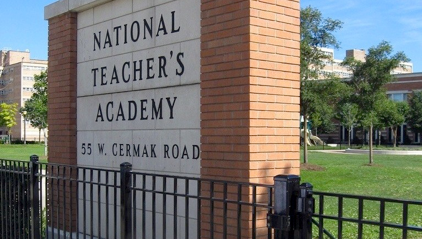
The National Teachers Academy
 |  |
Communities and Schools as Social Agents for Change
"All school communities have a base of resources that can be drawn on to leverage school change"-
(Organizing Schools for Improvement: Lessons from Chicago-Anthony S. Byrk)
Throughout my residency, I have had the great opportunity to work in three of the AUSL schools;The Chicago Academy in the Austin Neighborhood, The National Teacher's Academy in the Armour Square Neighborhood, and Curtis School of Excellence in the Roseland Community. Each school has its own individual identity within the context of the AUSL network and the dynamics of relationships and interactions amongst staff, parents, and community members was different at each site. My time in all three school settings has allowed me to gain an understanding of how positive school climates and relationships amongst staff, families, and community members is essential to the success of a school. Not only should a school environment offer students a safe and nurturing environment that will adhere to providing a rigorous and equitable educational experience, but is should be an environment that fosters the growth and development of all the members of its community.
As I take the next steps towards becoming a new member of a Turn Around Community at Marquette School of Excellence, I look forward to becoming a part of a team that will foster a positive school climate, so as to embrace some of the initial barriers that may come along with the dismantling of a prior school climate. My goal is to become an active member that will help create and support a common vision and language to set standards for student behaviors and academic expectations. My goals also include to establish positive and authentic relationships with students and families to be viewed as a partner in the significant process of change and utilized as a resource for growth and development. Through a strength based approach to instruction, along with a mantra to helping students to develop and become socially competent citizens, my job will be to create an environment that is reflective of:
"Having students perform well academically, develop tools of critical analysis and critical consciousness, have opportunities of intellectually rigorous curricula and high academic expectations, teaching that values and employs their cultural knowledge, and critical pedagogical approaches"
(The New Political Economy of Urban Education: Neoliberlism, Race, and the Right to the City- Pauline Lipman)

|
Context For Learning.doc.pdf Size : 114.606 Kb Type : pdf |
|
|
community walk.pdf Size : 161.354 Kb Type : pdf |
Schools as Systems and Bureaucracies
In the book “The Flat World and Education: How America’s Commitment to
Equity Will Determine our Future” Linda Darling Hammond argues that the
inequitable current educational structures within our society play a
significant role in the disconnection between our students’ academic and
social abilities when compared to other educational institutions at a
national and worldwide level. The current infrastructure within our
school systems does not adhere to complying with the essential need to
provide students with authentic learning experiences in which they are
allowed to develop their social, inquiry based, and critical thinking
skills. Darling Hammond argues that our society places little to no
value on reform and the distribution of financial resources for high
quality education. She confirms that in order for our society to develop
socially competent citizens that can thrive and positively impact our
society, then we must be able to adopt practices that focus on “the
quality of teachers and teaching, the development of curriculum and
assessments that encourage ambiguous learning by both students and
teachers, and the design of schools as learning organizations that
support continuous reflection” (pg. 8). Only then, would we be able to
move from a society that allows for unequal access to education for our
low-income and minority population of students.
As a resident in
training, I feel that the AUSL network has demonstrated its ability to
publicize their efforts as a current network that is determined to take
affirmative action towards the reform of school improvement. As I read
about several flourishing pedagogical practices that exist in other
countries, I wonder about how the AUSL network is willing and able to
construct the same sort of learning environments within their new
turnaround schools. Reading about peer assessment opportunities, the
integration of modern technology,use of student exploration with inquiry
based projects, and the decreased amount of topics that are taught in a
school year, I find a strong disconnection between daily practices that
I experience in my classroom. Unfortunately I feel that I have viewed
the ramifications of a test driven school environment that eliminates
individual responsibility for learning. Students are told what to think,
write, and do on a constant basis. Behavioral issues are rarely
addressed, and I find that my students constantly struggle with coping
skills and how to communicate effectively with others. As a new turn
around teacher, I envision the initial part of the school year dedicated
to character development and community building within our classroom,
so that students acquire the skills necessary to function within our
classroom, so that our learning can be reflective of some of a balanced
approach to content areas, mandated high stakes policies, but also
leaving room for authentic real-life experiences that revolve around
social justice curriculum.
During a professional learning meeting
this week, we discussed specific practices that could be adopted to
guide students towards developing intrinsic motivation for learning.
After reading chapter 1, I wonder how we can accomplish such a goal,
when society places little to no support in helping students from
low-income and minority populations. How can we expect students to hold
respect for education, when the education infrastructure does not
respect or support their individual learning?
